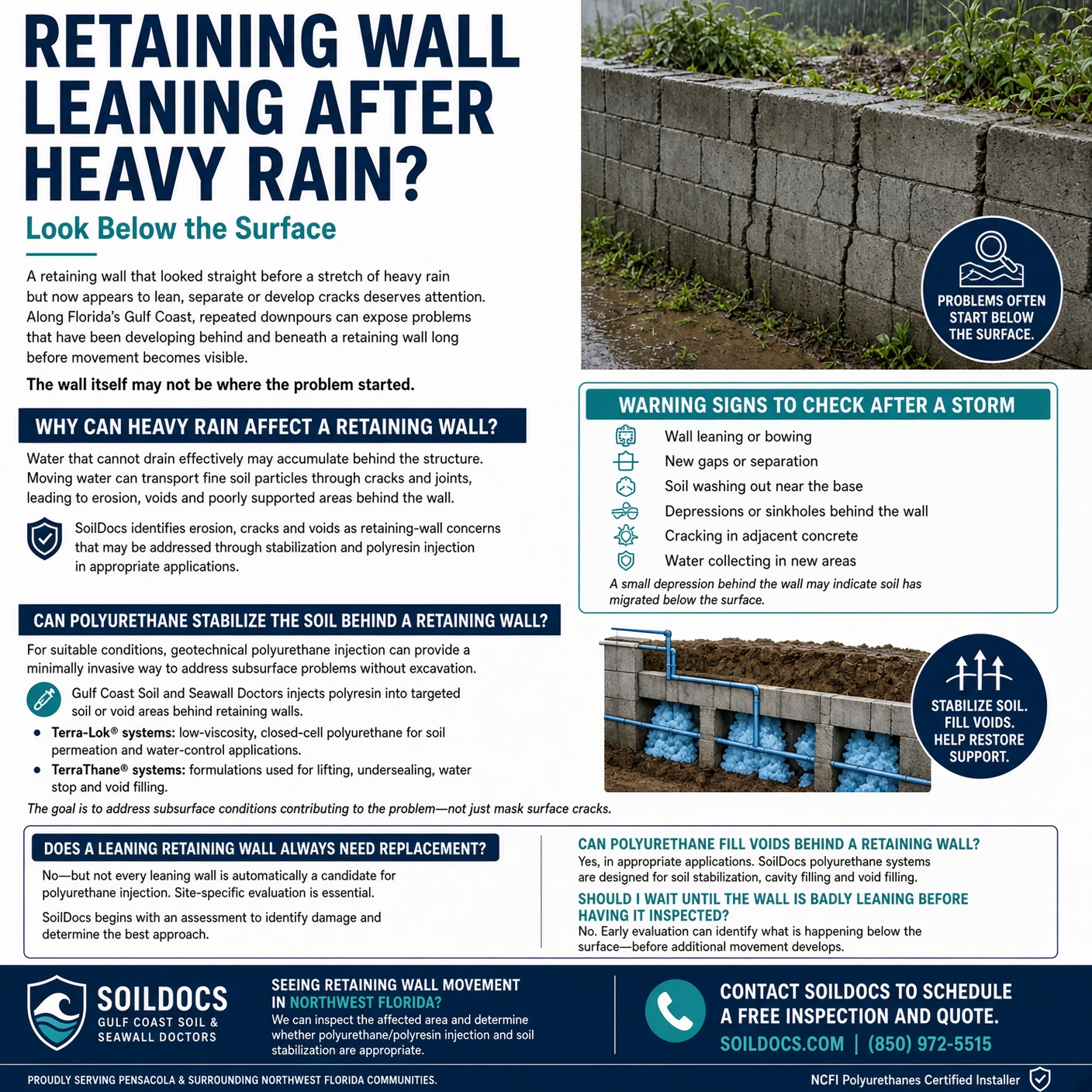
A retaining wall that looked straight before a stretch of heavy rain but now appears to lean, separate, or develop cracks deserves attention. Along Florida’s Gulf Coast, repeated downpours can expose problems that have been developing behind and beneath a retaining wall long before movement becomes visible.
The wall itself may not be where the problem started. Water movement, eroding soil, and hidden voids can compromise the material supporting the structure.
For property owners in Florida along the coast, recognizing those warning signs early can help determine whether stabilization is possible before the problem becomes more extensive.
Why Can Heavy Rain Affect a Retaining Wall?
A retaining wall has to resist the soil behind it. When that soil becomes saturated, conditions around the wall change.
Water that cannot drain effectively may accumulate behind the structure. At the same time, moving water can transport fine soil particles through cracks, joints, and other pathways. Over repeated rain events, this can contribute to erosion and leave poorly supported areas or voids behind the wall.
SoilDocs identifies erosion, cracks, and voids as retaining-wall concerns that may be addressed through stabilization and polyresin injection in appropriate applications.
Warning Signs to Check After a Storm
Walk the property from a safe location and look for changes rather than focusing only on large cracks.
Potential warning signs include a wall beginning to lean or bow, new gaps between wall sections, soil washing out near the base, depressions developing behind the wall, cracking in adjacent concrete, or water repeatedly appearing where it did not previously collect.
A small sink or depression behind the wall can be particularly important. The visible opening may be evidence that supporting material has migrated somewhere below the surface.
If a wall appears severely unstable or movement is progressing rapidly, keep people away from the affected area and have it professionally evaluated.
Can Polyurethane Stabilize the Soil Behind a Retaining Wall?
For suitable conditions, geotechnical polyurethane injection can provide a minimally invasive way to address subsurface problems without automatically excavating and replacing the entire structure.
Gulf Coast Soil and Seawall Doctors inject polyresin into targeted soil or void areas behind retaining walls. The material can expand into void spaces and help stabilize surrounding soil. SoilDocs’ Terra-Lok systems are low-viscosity, closed-cell polyurethane formulations designed for soil permeation and water-control applications, while TerraThane systems include formulations used for lifting, undersealing, water stop, and void filling.
This distinction matters: polyurethane is not simply being applied to hide a crack on the wall face. The objective is to address appropriate subsurface conditions contributing to the problem.
NCFI case-study material published by SoilDocs provides a useful example of this principle. At the William O’Huske Lock & Dam, water infiltration through wall joints caused soil loss, voids, settlement, and joint separation. Terra-Lok polyurethane was selected as part of the stabilization and water-intrusion solution.
Does a Leaning Retaining Wall Always Need Replacement?
No—but neither should every leaning wall automatically be considered a candidate for polyurethane injection.
The amount of movement, wall condition, drainage, soil loss, foundation conditions, and other site-specific factors need to be evaluated. SoilDocs begins its retaining-wall process with an assessment to identify damage and determine appropriate injection locations when polyresin stabilization is suitable.
Can polyurethane fill voids behind a retaining wall?
Yes, in appropriate applications. SoilDocs’ geotechnical polyurethane systems are designed for applications that include soil stabilization, cavity filling, and polyurethane foam void filling.
Should I wait until the wall is badly leaning before having it inspected?
No. New cracks, separation, soil washout, depressions, or noticeable movement after heavy rainfall provide reasonable grounds for an inspection. Earlier evaluation can help identify what is occurring beneath and behind the wall before additional movement develops.
Seeing Retaining Wall Movement in Northwest Florida?
If heavy rain has exposed soil washout, voids, or movement around your retaining wall, Gulf Coast Soil and Seawall Doctors can inspect the affected area and determine whether polyurethane/polyresin injection and soil stabilization are appropriate.
Contact SoilDocs to schedule a free inspection and quote.
Comments are closed