You fill a depression in the yard, level the soil, and assume the problem is solved. Then, after another stretch of Florida rain, the low spot returns.
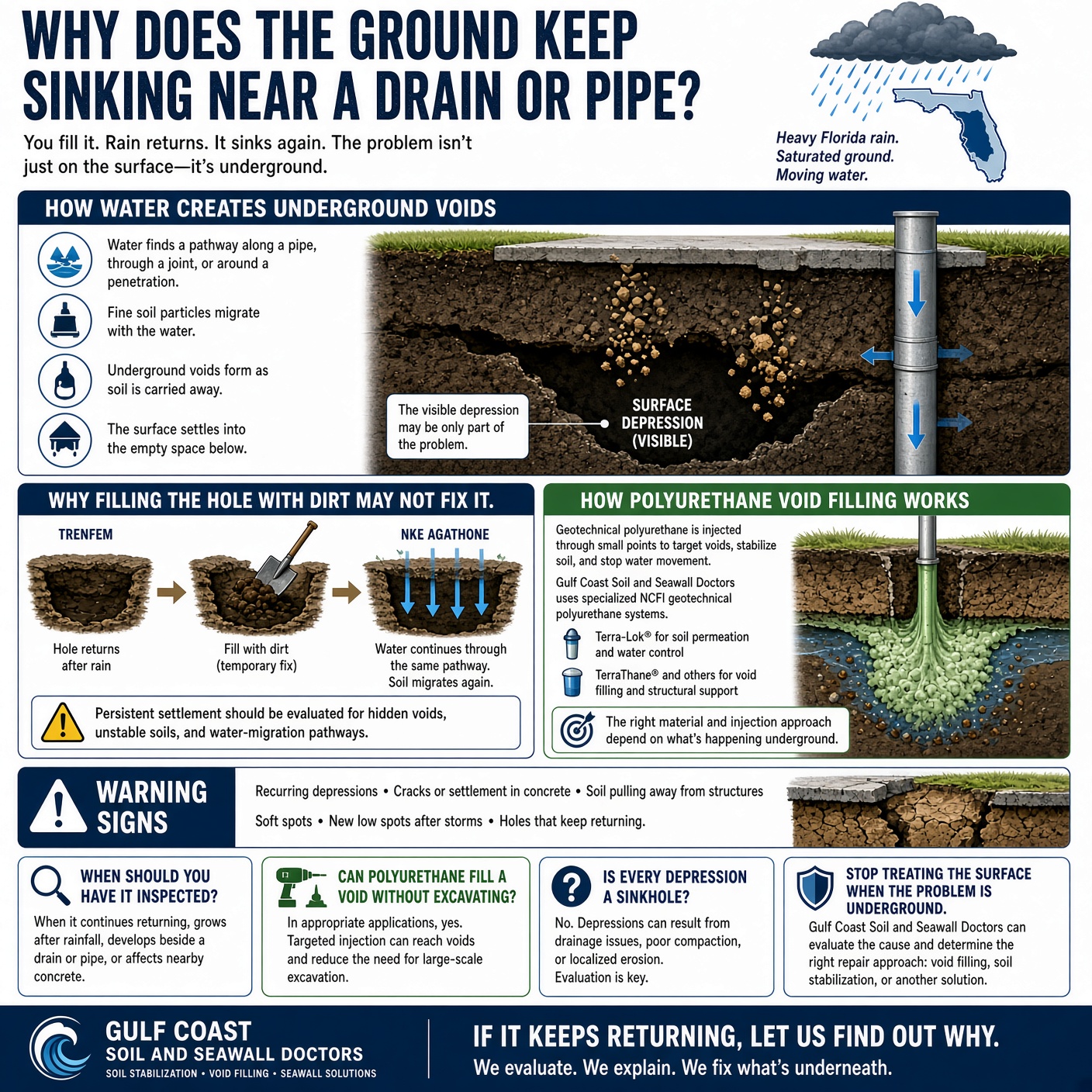
When ground repeatedly sinks around a drain, buried pipe, utility penetration, or concrete structure, the problem may be deeper than the surface. Water can migrate through gaps and weak areas below grade, carrying soil particles with it and gradually creating an underground void.
Adding more dirt may temporarily hide the depression. It does not necessarily stop the process causing the soil to disappear.
How Water Creates Underground Voids
Florida properties regularly deal with intense rainfall, saturated ground, and large volumes of moving water. If drainage water finds a pathway alongside a pipe, through a joint, or around a penetration, it can begin moving surrounding soil.
Fine soil particles can migrate with the water. As material is lost, unsupported spaces develop underground.
Eventually, the surface may settle into that space.
Warning signs can include recurring depressions, cracks, or settlement in nearby concrete, soil pulling away from a structure, unusually soft ground, new low spots after storms, or holes that repeatedly return after being filled.
The visible depression may represent only part of the affected area.
Why Filling the Hole With Dirt May Not Fix It
Replacing missing soil addresses what you can see. The more important question is why the soil disappeared in the first place.
If water can continue traveling through the same underground pathway, newly placed fill may also migrate.
That is why persistent settlement should be evaluated for hidden voids, unstable soils, and water-migration pathways rather than treated only as a landscaping problem.
How Polyurethane Void Filling Works
Gulf Coast Soil and Seawall Doctors uses geotechnical polyurethane systems for applications including soil stabilization, cavity filling and underground void filling.
Polyurethane can be delivered into targeted subsurface areas through relatively small injection points. Depending on the conditions and material selected, the resin can fill inaccessible voids, permeate loose soils, or help establish a barrier against unwanted water movement.
SoilDocs uses specialized NCFI geotechnical polyurethane systems. Terra-Lok single-component systems are designed for soil permeation and water-control applications, while TerraThane and other systems are available for applications including void filling and structural support.
The correct material and injection approach depend on what is happening underground, which is why identifying the cause matters before beginning a repair.
When Should You Have a Recurring Depression Inspected?
A depression deserves closer attention when it continues returning, grows after rainfall, develops beside a drainage structure or buried line, or is accompanied by movement in nearby concrete.
Early investigation can help determine whether the issue is ordinary surface settlement or evidence of a larger subsurface void.
Can polyurethane fill a void without excavating the entire area?
In appropriate applications, yes. Geotechnical polyurethane can be delivered through targeted injection points to reach underground voids, potentially reducing the excavation required to access the affected area.
Is every depression in a Florida yard a sinkhole?
No. Surface depressions can have many causes, including drainage problems, poorly compacted fill and localized soil erosion. The underlying cause should be evaluated rather than assumed.
Stop Treating the Surface When the Problem Is Underground
If a hole or depression on your Florida property keeps returning, Gulf Coast Soil and Seawall Doctors can evaluate the affected area and determine whether void filling, soil stabilization or another repair approach is appropriate.
Contact SoilDocs for an inspection and free quote.
Comments are closed