
Why Is My Driveway Sinking After Heavy Rain in Florida?
A driveway that suddenly looks lower on one side, develops an uneven joint, or begins separating from the garage may have a problem below the concrete—not necessarily with the concrete itself.
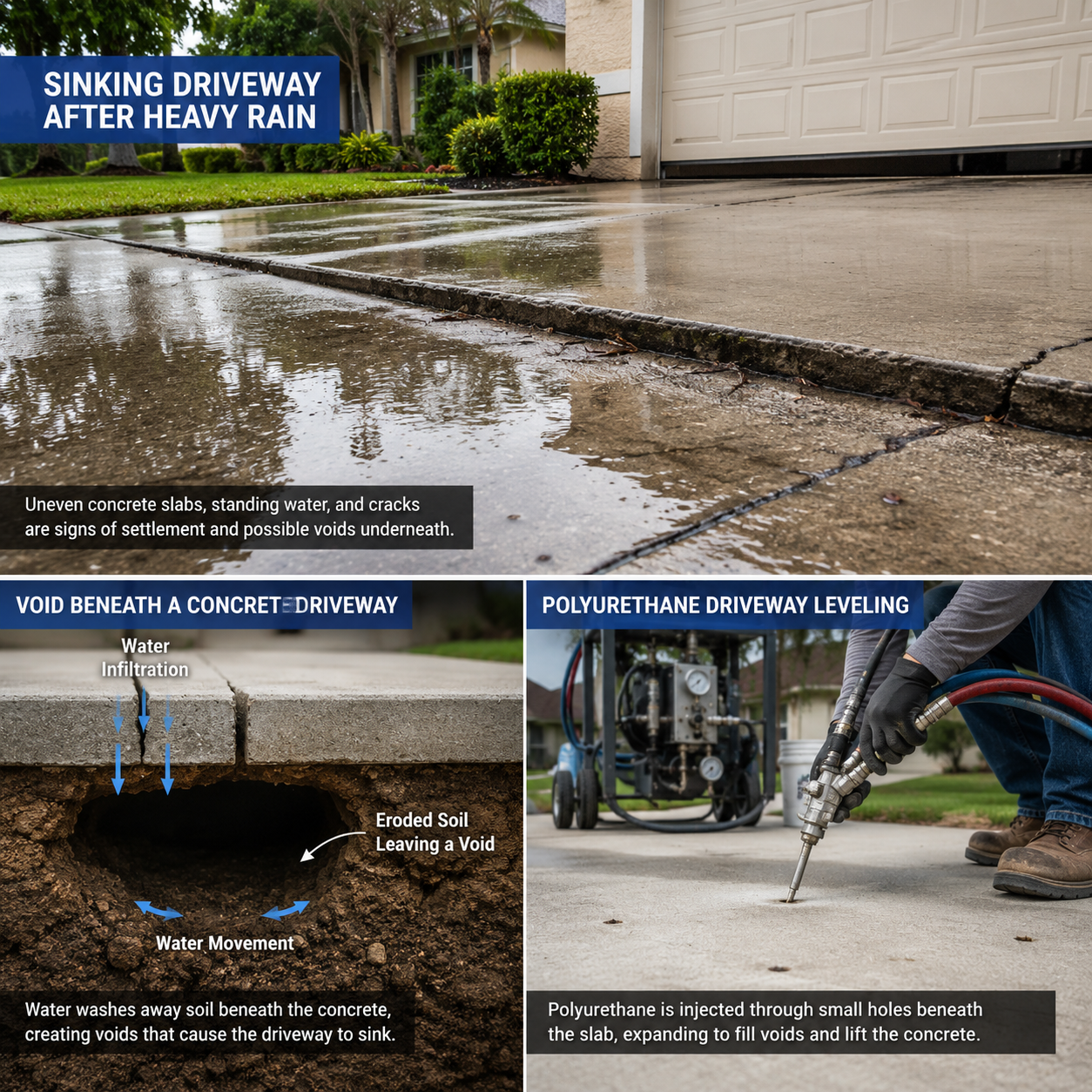
In Florida, repeated heavy rain can expose weaknesses in the soil supporting a driveway. Water moving beneath or around the slab can contribute to erosion, wash away supporting material, or worsen existing underground voids. Once the soil beneath the concrete can no longer provide consistent support, sections of the driveway may begin to settle.
What Causes a Concrete Driveway to Sink?
Concrete slabs depend on stable, compacted soil underneath them. When that support changes, the slab can move.
Common contributors to driveway settlement include:
- Soil erosion caused by water movement
- Poorly compacted fill beneath the original driveway
- Drainage problems around the slab
- Underground voids
- Repeated saturation of supporting soils
- Soil movement near foundations or utility trenches
Florida’s intense rain and naturally wet conditions can make drainage and soil stability especially important.
The damage may begin gradually. A homeowner might first notice water collecting in an area that previously drained correctly, a small height difference between two concrete sections, or a widening gap where the driveway meets the garage.
Signs There May Be a Void Under Your Driveway
A sunken slab is one warning sign, but there may be others.
Watch for cracking accompanied by settlement, rocking or unstable concrete, low spots that hold water, uneven joints, or sections of driveway pulling away from adjoining surfaces.
These problems should not automatically be treated as surface defects. Filling a crack does little to correct missing or unstable support underneath the slab.
The underlying condition needs to be evaluated first.
Can a Sinking Driveway Be Lifted Without Replacing It?
In many appropriate applications, yes.
Gulf Coast Soil and Seawall Doctors uses geotechnical polyurethane injection for concrete lifting, void filling, and soil stabilization.
Small injection holes are strategically placed through the affected concrete. Polyurethane resin is then introduced beneath the slab, where it expands into available spaces and can provide support while carefully raising settled concrete toward the desired elevation.
This process is commonly known as polyjacking or foam jacking.
Because polyurethane is lightweight compared with traditional cement-based lifting materials, it can provide support without adding substantial additional weight to already compromised soil.
The injection process also requires considerably less demolition than removing and rebuilding an entire driveway.
Why Fix Driveway Settlement Early?
Settlement rarely becomes more convenient with time.
An uneven driveway can create trip hazards, drainage problems, stress at adjoining concrete joints, and additional movement as water continues finding pathways beneath the slab.
Addressing the void or unstable soil beneath the concrete may help restore support before the affected area becomes more extensive.
Frequently Asked Questions
Does a cracked driveway always need to be replaced?
No. If the concrete remains suitable for repair and the primary problem is settlement or loss of support underneath it, polyurethane lifting may be an option. Severely deteriorated concrete may require a different approach.
How quickly can polyurethane-lifted concrete be used?
Polyurethane systems cure rapidly. SoilDocs notes that many concrete lifting and stabilization projects can be completed with minimal disruption and returned to service quickly.
Is Your Florida Driveway Starting to Sink?
If you have noticed uneven concrete, recurring puddles, widening joints, or a driveway settling near your garage, the problem may be underneath the slab.
Gulf Coast Soil and Seawall Doctors can evaluate the affected area and determine whether polyurethane concrete lifting, void filling, or soil stabilization is appropriate. Contact SoilDocs to schedule an inspection and request a free quote.
Comments are closed